

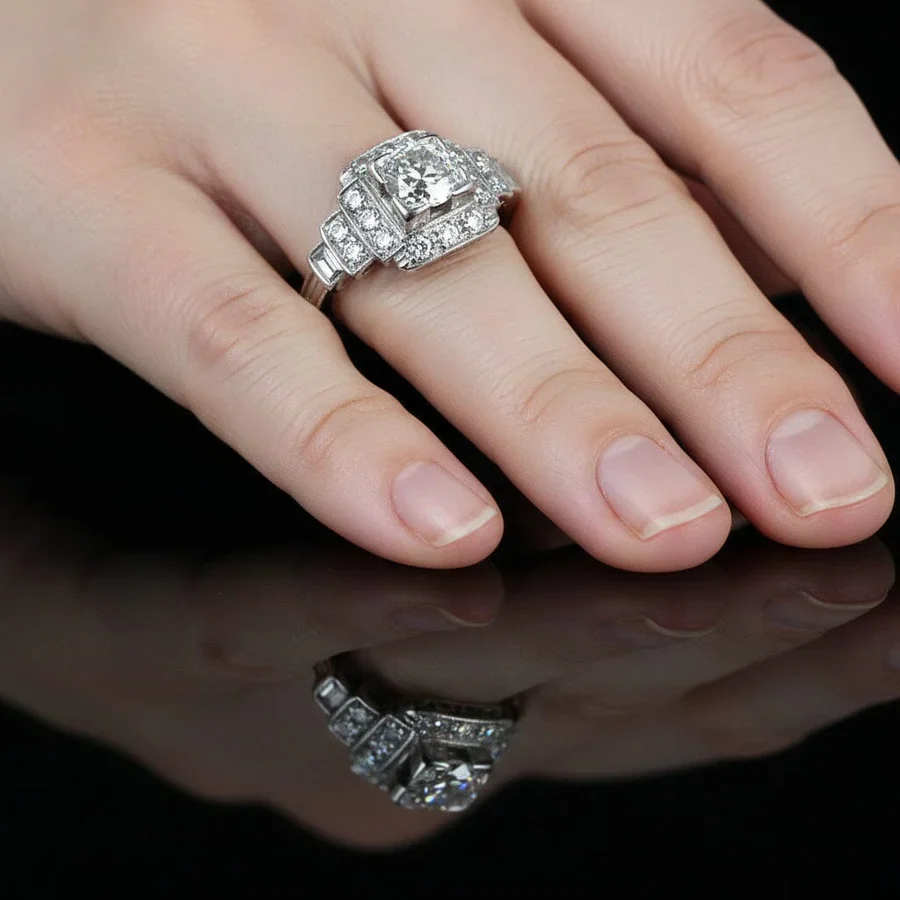
The Art Deco period has become the most imitated era in jewelry, which is a compliment to its designers and a problem for buyers. Search the term today and you will find a great deal of new manufacturing described as Deco inspired, Deco style, or vintage inspired, sitting alongside pieces that were genuinely made in the 1920s. Authentic Art Deco engagement rings are survivors of a specific twenty-year window, and once you know what that window produced, telling the two apart becomes far easier than most shoppers expect.
What actually defines the period
The Deco style ran from roughly 1920 to 1935, arriving after the delicate garland motifs of the Edwardian era and ending as Retro gold took over in the late thirties. Its logic was architectural. Designers worked in geometry, symmetry, and contrast: stepped shoulders, straight lines, bold color blocking, and a strong sense of the ring as a small piece of design rather than a mount holding a stone.
Platinum was the metal of choice, prized because its strength allowed the thin, precise settings the style demanded. White gold appears toward the end of the period, usually in more modest pieces.
Start with the diamond
This is where reproductions most often reveal themselves. Diamonds cut during the Deco years were old European cuts, and to a lesser extent transitional cuts as the thirties progressed. An old European cut has a small table, a high crown, and an open culet, which appears as a tiny circle when you look straight down through the top of the stone. The result is a chunky, warm flash of light rather than the fine needle sparkle of a contemporary stone.
If the center stone is a modern round brilliant with a pointed culet, a wide table, and perfectly even scintillation, the ring is either new or a period mount that has been reset. Neither is necessarily bad, but it is a different object with a different value.
Read the metal and the construction
Look inside the shank. American platinum pieces from the period commonly carry marks such as PLAT, 10% IRID PLAT, or IRIDPLAT, reflecting the iridium alloy in use at the time.
Construction tells you more. Period rings were largely die-struck and hand assembled, which produces dense, crisp metal with sharp interior edges. Modern reproductions are usually cast, and casting leaves softer detail and occasional porosity visible under magnification. Genuine hand engraving and milgrain show slight, pleasing irregularity under a loupe. Machine-applied detail is uniform in a way that looks correct at arm’s length and slightly lifeless up close.
The colored stone question
Calibré-cut sapphires, emeralds, and onyx set flush into geometric shoulders are a signature of the era. Here one point causes needless alarm: laboratory-created sapphires and rubies were widely used in perfectly authentic period jewelry, since flame fusion synthesis had been commercial since before the First World War. Finding a created sapphire in a 1928 ring is normal and does not make the ring a fake. What matters is that the seller identifies it correctly and prices accordingly.
What a century of wear looks like
An honest hundred-year-old ring shows its age somewhere. Prongs thin and are retipped. Shanks wear at the bottom and are sometimes replaced. Filigree occasionally cracks. None of this disqualifies a piece; it is expected, and a good jeweler will tell you what has been done.
Two things are worth asking before you buy. First, whether the ring can be sized, since heavily engraved or fully eternity-set shanks resist resizing. Second, whether the settings are secure enough for daily wear, because a ring worn every day for the next fifty years needs a different standard of soundness than one kept in a box.
Buying well
The shortcut through all of this is a specialist who examines every piece before it is offered and describes it plainly, including the repairs. Ask for the era, the cut of the stones, the metal, and the condition history in writing. A dealer confident in the merchandise will give you all four without hesitation.
To see how genuine period pieces are documented and described, browse the current inventory at Gesner Estate Jewelry, where each ring is hand selected and evaluated before it reaches the collection. The right one has already existed for a century. It is worth the patience to find it.
