

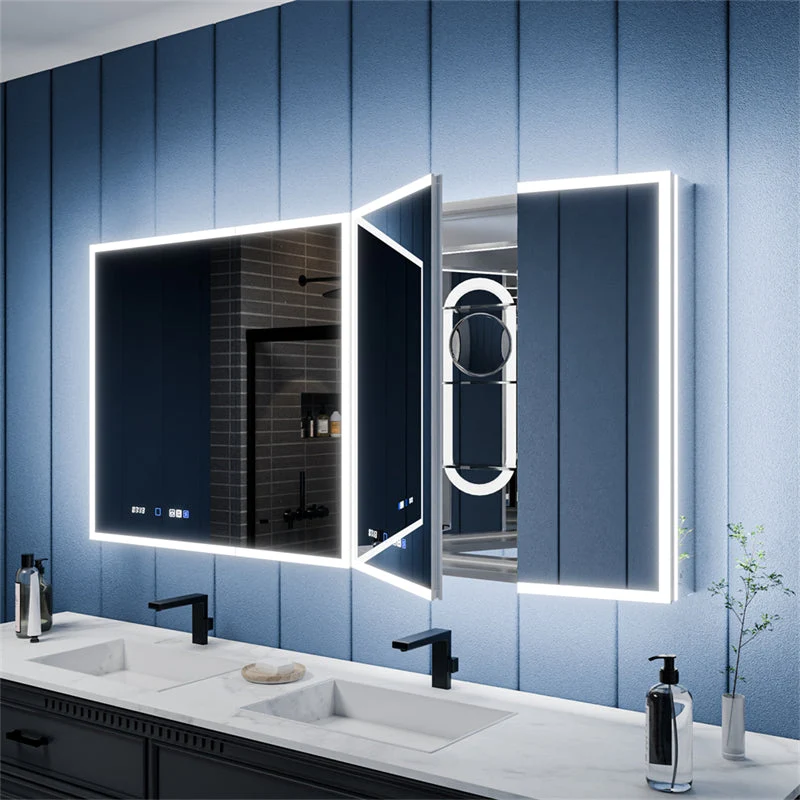
Bathroom lighting fails in a predictable way. The fixture sits on the ceiling, you lean toward the sink, and your own head throws a shadow across the exact part of your face you are trying to see. A medicine cabinet with mirror and lights fixes the geometry by moving the light source down to eye level, on the same plane as the mirror, so it lands on your face instead of the top of your head.
That is why lighted cabinets moved out of hotel bathrooms and into ordinary homes over the past several years. The hardware got better and cheaper. What did not get simpler is the spec sheet, so here is what actually separates a good unit from a regrettable one.
Why the combination works in a small bathroom
Wall space above a vanity is contested territory. The mirror wants the center, sconces want the flanks, and storage wants the same wall because nowhere else in the room is convenient. Combining all three removes the compromise.
- Footprint: one fixture instead of three, which matters in a powder room or a 5-by-8 layout
- Light placement: illumination at eye level rather than overhead, so shadows fall away from your face
- Storage gained: roughly four to six inches of interior shelf depth on a wall that was previously just a mirror
- The trade-off: swapping a sconce takes twenty minutes, while swapping a recessed cabinet means patching drywall
The two light specs that matter most
Most product pages lead with brightness. Brightness is the least useful number of the group. These are the specs worth reading closely.
- Color temperature (Kelvin): around 3000K reads warm and residential, 4000K is a safe neutral, and 5000K to 6000K is cooler and better for shaving or detail grooming. Adjustable models spanning 3000K to 6000K suit households where people want different things at different hours.
- CRI (color rendering index): this measures how accurately the light reproduces color against natural daylight. Below 80 will distort skin tone and make matching makeup unreliable. Look for CRI 90 or higher, and treat a missing CRI figure as a warning sign.
- Dimming: full brightness at 6 a.m. in a dark bathroom is genuinely unpleasant. A dimmable panel means you are not choosing between blinding and off.
- Anti-fog: a heating element behind the glass keeps a usable patch of mirror clear while the shower runs. It is the last feature people notice and the first they miss.
What lives behind the door
The storage half of the product gets less attention than the lighting, which is a mistake. It determines whether the cabinet reduces clutter or just relocates it.
- Adjustable shelving: fixed shelves waste vertical space, since a bottle of mouthwash and a tube of toothpaste have nothing in common dimensionally
- Interior power: some cabinets include built-in outlets, occasionally rated to 1800W, plus USB-A and USB-C ports. Charging an electric toothbrush and a razor inside the cabinet clears a surprising amount of counter surface.
- Soft-close hinges and magnetic catches: minor-sounding details until you live with a cabinet that slams at dawn
- Certification: confirm ETL or UL listing. A bathroom is a wet environment with mains voltage, and an unnamed certification body is a real gap rather than an oversight.
- Construction: stainless steel bodies hold up better than particleboard in a room that runs humid twice a day
Recessed or surface mount
This decision is structural, so settle it before you fall for a specific model.
Recessed sits inside the wall cavity and finishes nearly flush. It is the cleaner look and the better choice in a tight bathroom where a protruding box catches elbows.
- Standard 16-inch-on-center framing gives about 14.5 inches of clear width between studs
- A 2×4 wall gives roughly 3.5 inches of usable depth
- Plumbing stacks, vent lines, and electrical runs frequently occupy exactly the spot you wanted
Surface mount bolts to the finished wall and projects four to six inches into the room.
- Installation is far simpler and the wall stays intact
- You can generally go wider and deeper than a stud bay allows
- In a larger bathroom, the projection is barely noticeable
If you do not know what is behind your wall, a stud finder and a small inspection hole in a spot you will cover anyway will answer the question in ten minutes.
Settle these before you order
A short pre-purchase checklist prevents most of the returns that happen with this category.
- Measure the wall opening, not the mirror you currently have, and account for any backsplash or vanity light you plan to keep
- Check the vertical clearance from vanity top to ceiling, since a tall cabinet in a low-ceiling bathroom crowds the sightline
- Decide how it gets power: hardwired gives the cleanest result and usually needs an electrician if there is no junction box in the wall, while plug-in models need an outlet within cord reach
- Confirm the mounting method, including whether no-drill options exist for your wall type
- Read the installation documentation before you buy, not after the box arrives
Support is worth more than a marginal price difference here. Retailers such as Allsumhome that publish detailed installation guidance and offer engineer support by phone make a weekend project realistic for a competent DIYer, and a well-chosen medicine cabinet with mirror and lights will improve how the room works every morning rather than just how it photographs.
