

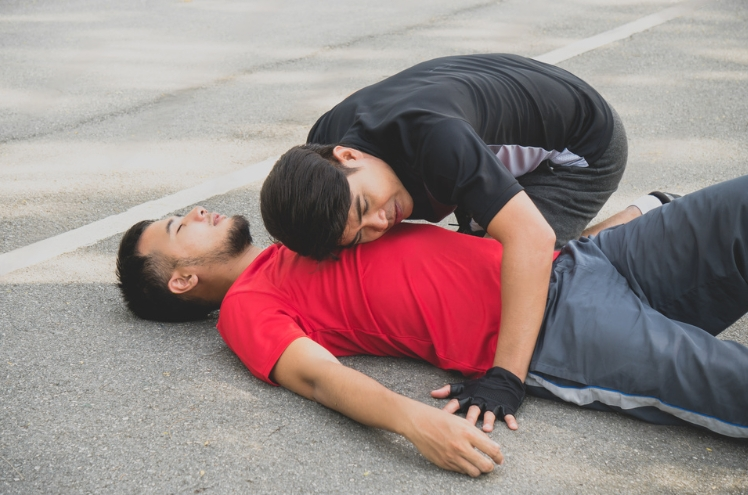
Most people who have taken a CPR course learned it in the context of cardiac arrest, where the heart stops first and the airway is clear. A choking emergency inverts that sequence: the airway blocks first, and the heart stops afterward because oxygen has run out. Knowing how CPR differs in an unresponsive adult choking victim matters because the modifications are small in number but decisive in effect, and the American Heart Association addressed choking directly for the first time in its 2025 guidelines revision.
What happens before the collapse
For a conscious adult with a severely obstructed airway, current guidance calls for alternating five back blows with five abdominal thrusts, repeating until the object comes out or the person becomes unresponsive. Back blows as the opening step is a change from earlier guidance. For someone who is pregnant or of a body size that makes abdominal thrusts impractical, chest thrusts replace them.
The moment the person loses consciousness, this phase ends. Do not continue thrusts on a collapsed victim. Lower them carefully to a firm, flat surface, ensure emergency services have been called, and send someone for an AED if one is nearby.
The differences that matter
Start compressions immediately. For a lay rescuer, there is no pulse check. Recognition rests on responsiveness and breathing effort, and you already know why this person stopped breathing because you watched it happen. Begin standard adult compressions at the center of the chest.
Look in the mouth before every set of breaths. This is the single defining modification. Each time you open the airway to ventilate, take a fast look inside. If you can see the object, remove it. If you cannot see it, do nothing and proceed with the breath.
Never perform a blind finger sweep. Sweeping a finger through an airway you cannot see is capable of pushing a partially dislodged object deeper and wedging it more firmly. Remove only what is visible.
Expect compressions to help clear the airway. Chest compressions generate meaningful pressure in the airway, which is part of why they are the right tool once someone is on the ground. The compressions are doing two jobs at once.
Reposition if a breath will not go in. If the chest does not rise, tilt the head back and lift the chin again, then reattempt. A poor airway position accounts for more failed breaths than the obstruction itself.
Why breaths matter more here
Hands-only CPR has been promoted heavily and for good reason: it saves lives in sudden cardiac arrest, where the blood still holds usable oxygen for the first several minutes, and it removes the hesitation that stops bystanders from acting at all.
A choking arrest is different. By the time the person collapses, they have already been oxygen-starved for a period, and circulating blood that carries no oxygen accomplishes very little. The 2025 guidelines recommend compressions combined with breaths for both healthcare professionals and lay rescuers who are willing and able. If you are trained and equipped, use breaths here.
After the object comes out
Clearing the obstruction does not end the emergency. If the person is still unresponsive and not breathing normally, continue CPR. Anyone who has been unconscious from choking needs medical evaluation even if they recover quickly, because aspiration and airway injury can develop over the following hours.
Reading this is not the same as being able to do it
The sequence above is short enough to memorize in five minutes. Performing it while someone’s face changes color in front of you is a different task entirely, and it depends on having rehearsed the movements until they run without deliberation.
That’s the case for training rather than reading. The courses at Simple CPR cover choking response as part of CPR and first aid instruction, built around current resuscitation guidelines and structured so that you can work through them at your own pace. The interval between recognizing a choking emergency and acting on it should be measured in seconds, and that only happens if the sequence is already familiar.
