

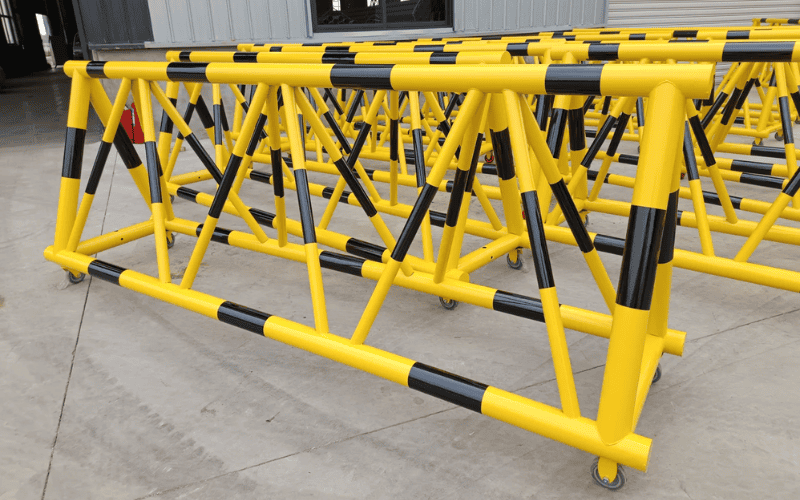
In the demanding sectors of urban construction and large-scale public safety, “heavy-duty” is more than a marketing term; it is a structural necessity. When managing thousands of commuters at a transit hub or securing a high-traffic metropolitan work zone, the physical pressure exerted on a perimeter can be immense. Standard retail-grade barriers often buckle under the lateral force of a surging crowd or the environmental stress of long-term outdoor deployment. For 2026, the industry has shifted toward a more robust infrastructure model, prioritizing heavy duty crowd control barriers that utilize reinforced steel and advanced galvanization. These systems are engineered not just to guide movement, but to serve as a formidable physical shield in the most high-pressure environments across North America.
The Anatomy of 16-Gauge Strength
The primary differentiator in heavy-duty barricades is the gauge and diameter of the steel tubing. Professional-grade units typically utilize 16-gauge steel, which provides the ideal strength-to-weight ratio for manual deployment while ensuring the frame does not bend under duress.
- The Main Frame: High-quality barriers often feature a 1.5″ OD (Outer Diameter) frame, providing a much sturdier foundation than the 1″ frames found in “value” models.
- Full-Saddle Welds: Unlike spot-welding, which can snap under vibration or impact, heavy-duty units use full-saddle welds where every upright is inserted into the frame before being welded 360 degrees. This creates a monolithic structure that can withstand years of loading and unloading from transport carts without the joints cracking.
Hot-Dipped Galvanization: Internal and External Protection
For site managers, the greatest enemy of equipment ROI is corrosion. Many barriers on the market are “pre-galvanized,” meaning the steel is coated before it is cut and welded, leaving the joints vulnerable to rust. True heavy-duty barriers undergo a “hot-dipped” process after fabrication. The entire unit is submerged in a vat of molten zinc, coating both the exterior and the interior of the tubes.
This prevents the “internal rot” that often causes older barriers to fail unexpectedly. This level of protection is essential for coastal venues or winter construction sites where salt and moisture are prevalent. A hot-dipped finish ensures the barrier remains professional in appearance and structurally sound for decades, significantly lowering the total cost of ownership over the product’s lifespan.
The Interlocking Hook System and Structural Unity
A single barrier is only as strong as its connection to the next. The “male/female” hook system in heavy-duty models is designed with an angled top hook to ensure a “true interlock.” This prevents the barriers from being easily unlinked by unauthorized individuals or separated by the uneven swaying of a crowd. When 20 or 30 units are linked together, they function as a single, multi-ton wall of steel. This structural unity is what prevents “perimeter breaches” during high-profile events or in restricted areas where unauthorized access could lead to catastrophic safety failures.
Base Versatility: Bridge vs. Flat Feet
Operational flexibility is a hallmark of professional gear. Heavy-duty systems are rarely “one-size-fits-all,” as the substrate of the site dictates the stability of the barrier.
- Bridge Feet: These are the standard for uneven terrain like grass, gravel, or dirt. The four-point contact system provides maximum stability against side-loading and prevents the barrier from wobbling on irregular surfaces.
- Flat Bases: Crucial for urban environments and sidewalks, these “anti-trip” bases feature a low-profile design that minimizes the risk of pedestrian falls. They also frequently include pre-drilled holes for permanent bolting if a semi-permanent queue or perimeter is required.
Conclusion: A Professional Commitment to Safety
The infrastructure you choose for your site is a direct reflection of your commitment to public safety and operational excellence. In an era where security protocols are under constant scrutiny, utilizing equipment that meets the highest engineering standards is a non-negotiable part of a modern operational plan. A high-quality barrier system doesn’t just manage people; it manages risk. When your project demands unyielding durability and a professional aesthetic that stands up to the rigors of the field, Epic Crowd Control provides the industrial-grade solutions and precision logistics required to secure and organize the most high-pressure environments with absolute confidence.
