

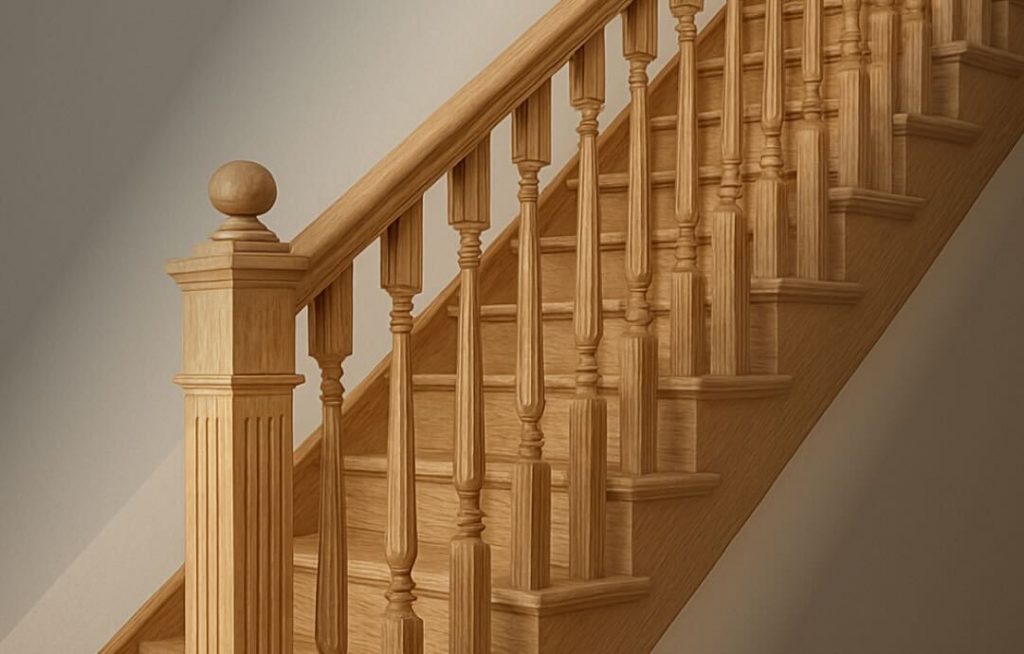
A stair handrail should never be selected as an isolated decorative component. It must provide a comfortable gripping surface while connecting correctly with balusters, newel posts, fittings, landings, and the staircase itself. Flooring dealers, contractors, builders, architects, and designers can prevent costly ordering errors by planning the entire railing system before choosing a rail profile.
Begin With Safety and Code Requirements
Appearance matters, but the primary purpose of a handrail is to give people a secure surface to hold while using the stairs. The selected profile, mounting height, clearance, continuity, and return conditions must follow the codes that apply to the project.
Requirements can vary according to location, building type, stair width, and whether the project is residential or commercial. Project teams should confirm the applicable rules with the local building authority rather than relying on general online guidance.
Code review should happen early. A visually appealing rail profile may not work if its dimensions, mounting arrangement, or fittings fail to provide the required gripping surface.
Select a Profile That Fits the Interior
Wood handrails are available in traditional, transitional, contemporary, and modern profiles. Rounded and molded profiles tend to complement traditional interiors, while square or simplified shapes often suit contemporary spaces.
The scale of the rail should also relate to the staircase. A wider profile can feel appropriate on a broad staircase with large newel posts. A smaller profile may look better on a compact staircase where a heavy rail would dominate the space.
Designers should consider the view from both floors. Because the handrail runs through several sightlines, its shape has a strong influence on how the staircase relates to the surrounding architecture.
Understand Plowed and Non-Plowed Rails
A plowed handrail contains a routed channel on its underside. This channel is commonly used with square-top wood balusters. Fillet pieces are installed between the balusters to cover the remaining portions of the channel.
A non-plowed handrail does not have this routed channel. It may be used with pin-top wood balusters, iron balusters, brackets, or other installation methods that do not require square balusters to sit within a plow.
The baluster style and dimensions should be chosen before the plow configuration is ordered. A channel that is too wide or too narrow for the balusters can create fit problems, additional labor, and an uneven finished appearance.
Coordinate Balusters and Newel Posts
The handrail, balusters, and newel posts must function as a connected system. Balusters fill the space below the rail, while newel posts provide major connection and termination points.
Traditional wood balusters can create a consistent material story across the staircase. Iron balusters introduce contrast and may help lighten the visual weight of a wood railing. Both approaches can work when the rail profile, baluster dimensions, mounting method, and fittings are compatible.
Newel posts should be scaled to the handrail and staircase. A narrow rail paired with an oversized box newel may look unbalanced, while a substantial rail can overwhelm a small post. Connection details should be confirmed before materials are purchased.
Match the Rail With Treads and Flooring
The handrail does not have to match every wood surface exactly, but the selections should look intentional. Using the same wood species for the treads and rail is a straightforward way to create visual continuity.
When different species are used, compare their grain patterns and undertones before selecting a stain. Red oak, white oak, maple, and other hardwoods can respond differently to the same stain color.
Finish sheen deserves attention as well. A glossy handrail may stand out against matte treads even if the colors are similar. Physical samples should be reviewed beside the flooring, stair treads, trim, and nearby cabinetry under the lighting found in the home.
Plan Every Fitting and Transition
Straight lengths of handrail are only part of the material list. Many staircases also require fittings to navigate changes in direction, connect sloped rails to level rails, return rail ends, or transition around landings.
Each fitting must match the selected handrail profile. Components made for different profiles may not align correctly, even when their overall dimensions seem similar.
Prepare a drawing that identifies starting points, termination points, wall returns, goosenecks, transitions, turns, landings, and newel locations. Curved stairs or balconies may require bending rail rather than standard straight sections.
A complete fitting plan reduces field modifications and gives the installer a clearer path for assembly.
Measure Before Ordering
Measure each railing run rather than estimating from the number of steps. Account for slopes, transitions, fitting connections, end cuts, and any additional material required for proper installation.
Long sections may be difficult to transport through doorways or around interior corners. Shipping limits and job-site access should be considered when selecting rail lengths. At the same time, unnecessary joints should be avoided where a continuous length can be safely delivered and installed.
Before placing the order, verify the profile number, wood species, plow size, length, fittings, baluster type, newel style, finish, and installation method.
Treat the Handrail as Part of the Architecture
A well-planned railing system combines safety, proportion, material coordination, and accurate component selection. Making these decisions early helps contractors reduce field adjustments and gives designers greater control over the finished staircase.
To compare wood handrail profiles, compatible stair parts, species, lengths, and finish choices for an upcoming project, visit Wood Stair Co and begin assembling a railing system that fits both the staircase and the surrounding interior.
