

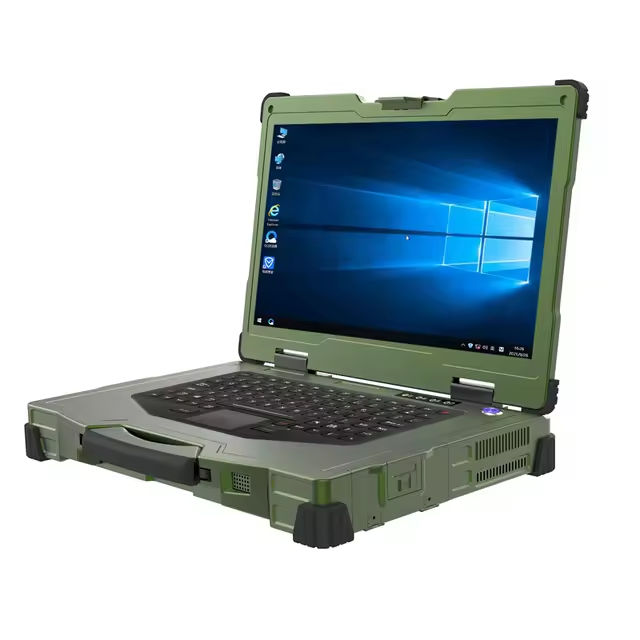
When a laptop is described as military-grade, the claim may sound reassuring, but it does not tell buyers precisely how the device was tested. Understanding the military standard MIL-STD-810G helps procurement teams, field technicians, and business owners look beyond general durability language. The standard provides a framework for evaluating how equipment responds to environmental stresses such as shock, vibration, temperature changes, humidity, dust, and water exposure.
What Does MIL-STD-810G Mean?
MIL-STD-810G is a United States Department of Defense test-method standard introduced in 2008. It was created to help organizations assess whether equipment could withstand the environmental conditions expected during storage, transportation, and operation.
The standard is not a single test that every rugged laptop must pass. It contains numerous laboratory methods covering different environmental conditions. Manufacturers select the methods that relate to the device’s intended use and establish suitable test procedures and severity levels.
This distinction matters because two laptops can both carry a MIL-STD-810G claim while having undergone different tests. One model may have been assessed for drops, vibration, and temperature extremes, while another may only have been tested under a narrower set of conditions.
Common Tests Applied to Rugged Laptops
Several MIL-STD-810G methods are particularly relevant to laptops used in construction, public safety, utilities, transportation, manufacturing, and field services.
Shock and Drop Testing
Shock testing assesses how a device responds to sudden physical forces. For laptops, this may include handling drops, impacts, or abrupt movements during transportation.
However, buyers should not assume that every tested laptop was dropped from the same height or onto the same surface. Test height, device orientation, packaging, operating status, and number of drops can all affect the results.
Vibration Testing
Vehicles, heavy equipment, aircraft, and industrial machinery can expose computers to frequent or continuous vibration. Vibration testing evaluates whether internal parts, ports, drives, screens, and mounting points remain functional under these forces.
This category is especially important when laptops will be installed in service vehicles, emergency response units, warehouses, or equipment cabins.
High and Low Temperatures
Consumer laptops are generally designed for controlled indoor settings. Field computers may face direct sunlight, freezing temperatures, unheated storage areas, or rapid movement between indoor and outdoor locations.
MIL-STD-810G includes separate methods for high-temperature exposure, low-temperature exposure, and temperature shock. Buyers should determine whether the laptop was operational during testing or merely stored under the stated conditions.
Dust, Sand, Humidity, and Rain
Fine particles can enter ports, damage fans, obstruct keyboards, and interfere with internal components. Moisture creates additional risks, including corrosion and electrical failure.
Environmental testing can help assess these threats, but MIL-STD-810G should not be confused with an IP rating. An IP rating specifically describes protection against solid-particle and liquid ingress. Reviewing both sets of information can provide a clearer picture of a laptop’s physical protection.
Compliance Does Not Mean Every Test Was Completed
MIL-STD-810G is a testing framework rather than a universal product certification program. There is no single government office that examines and certifies every commercial laptop advertised under the standard.
A manufacturer may perform testing internally, use an independent laboratory, or base a claim on selected procedures. For that reason, the words “tested,” “compliant,” and “certified” should not automatically be treated as interchangeable.
Buyers should ask which methods were completed, what conditions were used, whether the laptop was operating during the tests, and whether reports are available. Independent laboratory documentation can provide added confidence, but the details of the test remain more informative than a military-grade label by itself.
Match the Tests to the Working Environment
The right rugged laptop is not necessarily the one associated with the greatest number of tests. It is the model tested against hazards that resemble the buyer’s actual working conditions.
A technician working from a moving utility vehicle may place greater importance on vibration resistance and secure mounting. A construction supervisor may prioritize drop, dust, rain, and sunlight readability. Teams operating in cold storage or desert environments should pay close attention to operating temperature ranges and battery behavior.
Other purchasing factors also matter. Screen brightness, glove-compatible controls, port covers, battery options, carrying handles, docks, wireless connectivity, warranties, and repair support can directly affect daily use. MIL-STD-810G results should therefore be treated as one part of a wider equipment assessment.
A ruggedness claim becomes useful only when buyers understand the testing behind it. Before selecting a field computer, review the documented methods, compare them with expected hazards, and consider how the complete configuration will support the user’s work. Visit Tough Rugged Laptops to compare rugged computing options and find a laptop suited to demanding field, vehicle, industrial, or public-safety applications.
